Test results, milestones and announcements from the AeroStator Core™ programme.
8 kW/kg continuous — on a 125 g motor
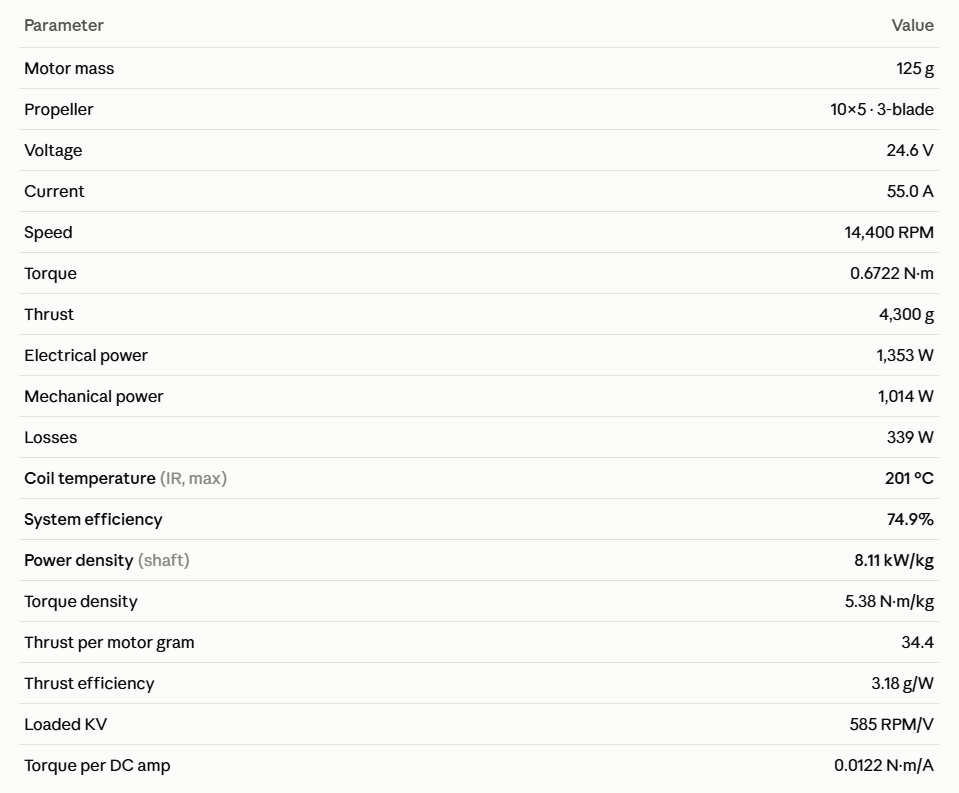
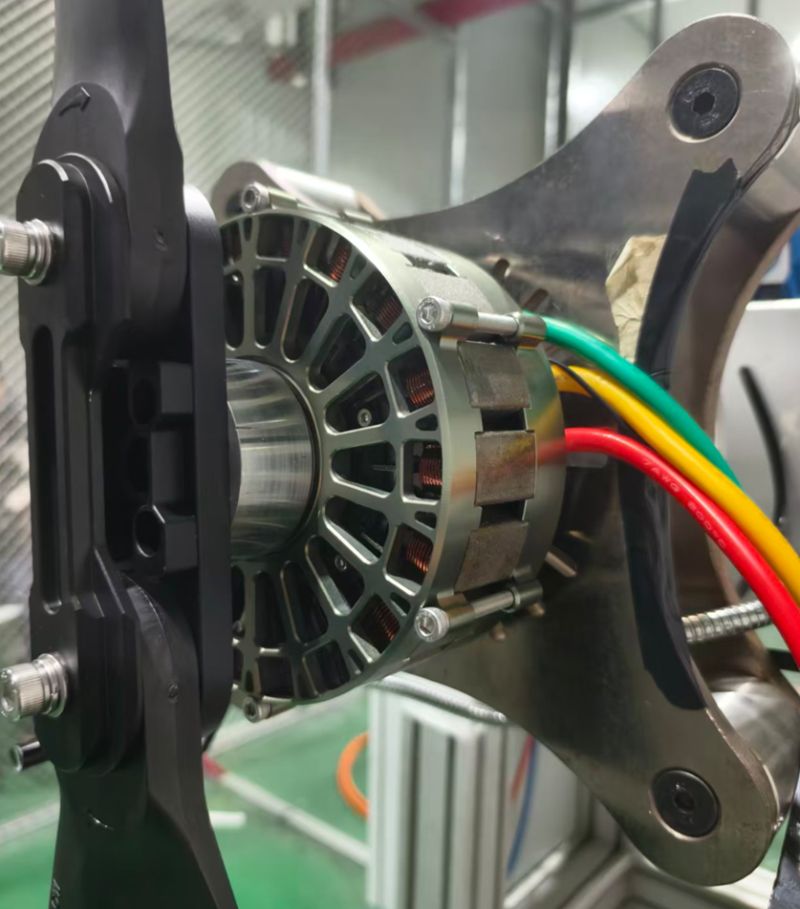
We just measured 1,014 W of continuous shaft power from the CIANO14 40_12 — 8.11 kW/kg from a 125-gram motor, on a 3-blade 10×5 propeller at 24.6 V / 55 A.
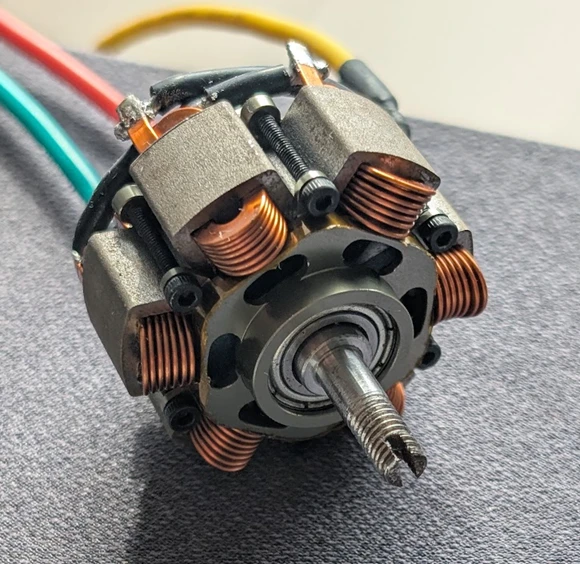
What makes it possible: the AeroStator Core™ topology gives twice the stator cooling surface of a conventional design; rectangular wire coils halve the winding resistance — and the solid copper cross-section doubles as a heat sink, so the same part that generates less heat also carries it away; and an optimized drive, achieved together with FOURnamics GmbH and their nCTRL ESC.
Continuous shaft power
1,014 W
Power density (shaft)
8.11 kW/kg
Thrust
4,300 g
Speed
14,400 rpm
System efficiency
74.9 %
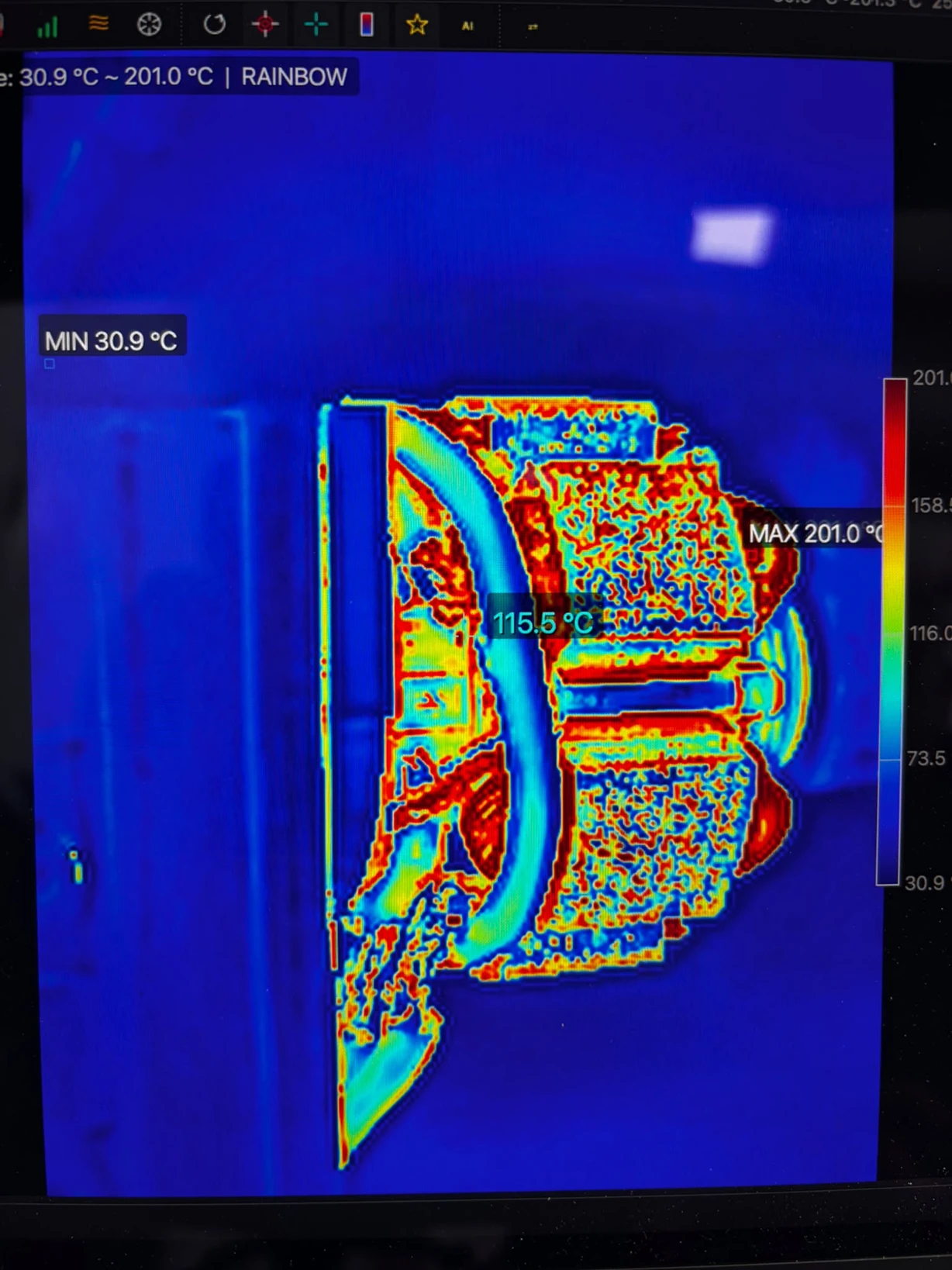
Coil temperature
201 °C (IR, max)
A stator topology can only deliver what the ESC lets it deliver — and nCTRL let it deliver everything.
Half the mass, same thrust class — CIANO14 vs the 4215 heavy-lift motors
Want to take half a kilo off your quadcopter without giving up efficiency? Look at your motors — that is where the weight is hiding. The 4215-class motors most heavy-lift quads fly weigh 257–262 g each. The CIANO14 40_12 weighs just 125 g — and covers the exact same thrust envelope.
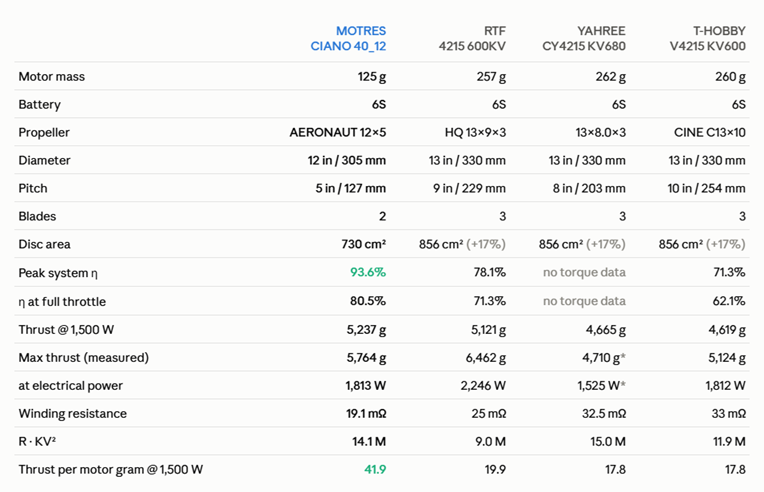
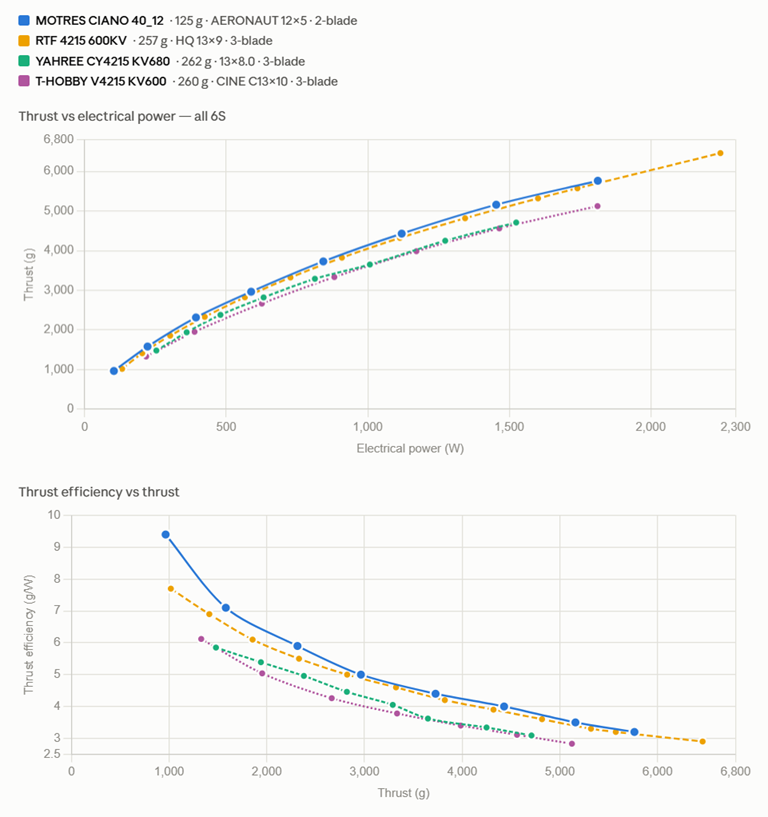
Together with FOURnamics GmbH and their nCTRL ESC we benchmarked the CIANO14 40_12 against three 4215-class motors on the same 6S bench (AERONAUT 12×5 2-blade):
Peak system efficiency
93.6 % (motor + ESC)
Best 4215 in test
78.1 %
At full throttle
80.5 % vs 71.3 %
Weight saved
>125 g per motor · ~500 g per quad
Thrust @ 1,500 W
5,237 g — best in test
Thrust per motor gram
41.9 — 2.1× the best 4215
Every aerodynamic advantage was on the competitors’ side — their 3-blade 13″ props offer ~17 % more disc area than our 2-blade 12″ — yet the CIANO14 still delivered superior efficiency.
And 500 g off the airframe is never just 500 g: it means less thrust required to hover, lower current draw, and extended flight time — or the ability to carry 500 g more payload with zero penalty. Half the mass. Same thrust class. Higher efficiency.
Two coaxial motors, or one bigger prop? The payoff is flight time
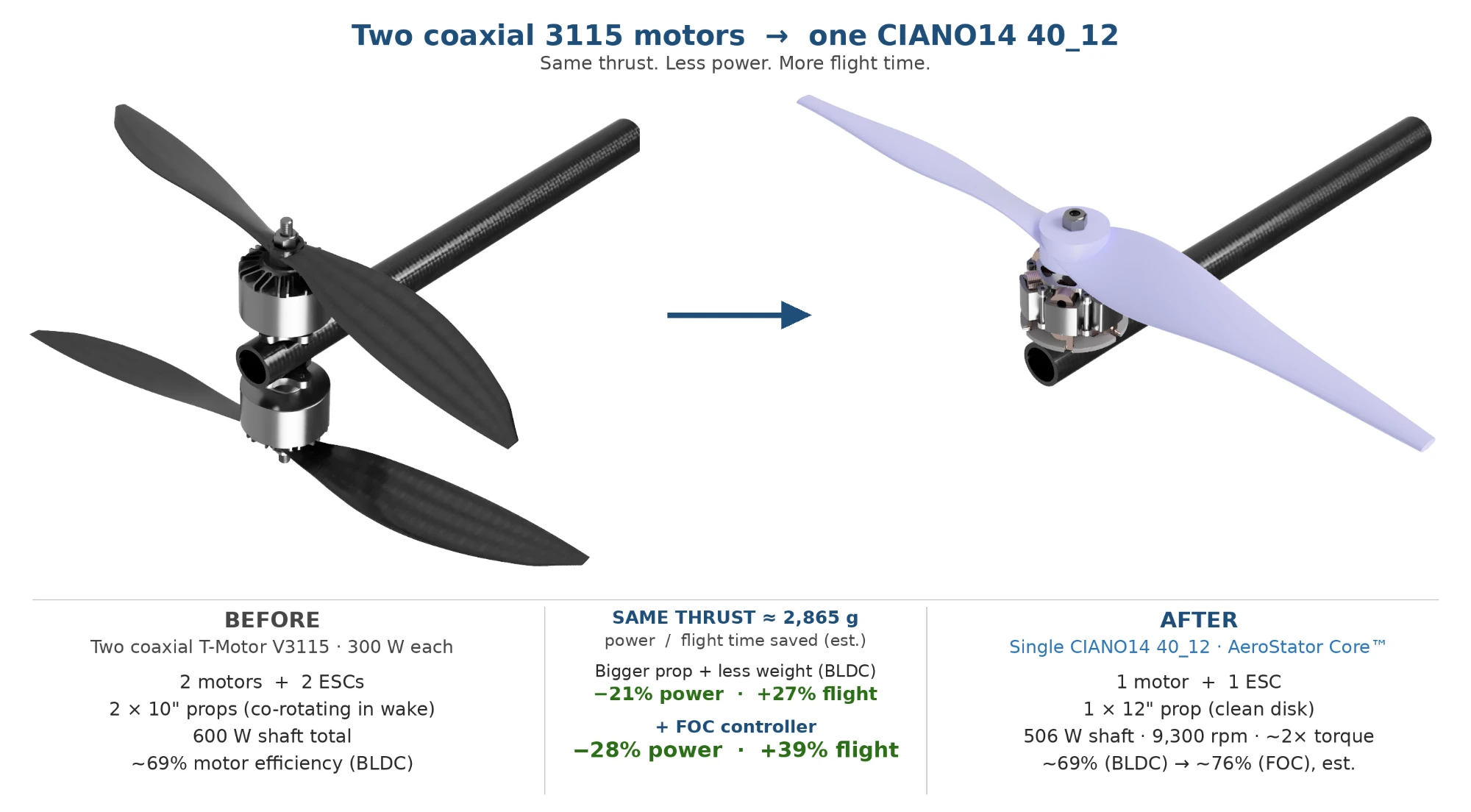
A common heavy-lift setup: a coaxial pair of T-Motor V3115 on 10″ props — 600 W of shaft power. But coaxial props fight for the same air — the lower one loses ~20 % of its efficiency in the wake of the upper.
Our proposal: replace them with one CIANO14 40_12 on a 12″ prop, tuned to the same thrust. On AeroStator Core™ technology. Same thrust (~2,865 g), same battery:
Standard BLDC
−21 % power · +27 % flight
With FOC controller
−28 % power · +39 % flight
Weight removed
~167 g (1 motor + 1 ESC)
Single 12″ prop
506 W shaft · 9,300 rpm
Torque demand
~2× vs 10″
Efficiency
~69 % (BLDC) → ~76 % (FOC, est.)
The catch: the single 12″ prop runs at ~2× the torque — where our flat-wire winding earns its place, holding high torque at high efficiency without overheating.
These figures are an estimate — the 12″ operating point is modeled from our measured 10″ data. Bench validation on 12″ is next, and we’ll publish the numbers. AeroStator Core™ is open for licensing and co-manufacturing partners.
84.2 % system efficiency on FOC — the CIANO14 40_12 completes its sinusoidal round
We just finished the FOC round on the CIANO14 40_12 — our 125-gram 3115-class inrunner, built on AeroStator Core™. Peak system efficiency (controller + motor, measured at the bus) reached 84.2 %, holding an 82–84 % plateau across the working range. For comparison, our earlier run on a trapezoidal BLDC controller peaked at 76.9 %.
Peak system efficiency
84.2 %
Efficiency plateau
82–84 %
vs trapezoidal BLDC
+7 pp (76.9 % peak)
Propeller
10×4.5 · 2-blade
Bus voltage
22 V
Testing
Propeller dyno · 12-point sweep
Why it matters: a standard 3115 motor tops out around 300–350 W continuous. This one sustains 6 kW/kg — more than 2.5× the continuous power of any 3115-class motor we’ve benchmarked against. Same form factor, 2.5× the sustained output. In UAV propulsion, every single watt-hour saved is extra payload and flight time.
We ran the CIANO14 40_12 on a propeller test stand for 30 minutes straight — roughly 2.5× the sustained power of any 3115-class motor on the market. Here’s what the stand logged at minute 29 (125 g motor):
Thrust
3,455 g
Shaft power
770 W (6.16 kW/kg)
Electrical input
1,038 W
System efficiency
74.2 %
Current
43.85 A @ 23.7 V
Max temp
150 °C (stabilized)
A standard 3115 tops out at 300–350 W continuous before hitting thermal limits. Same form factor — 2.5× the sustained power. The winding stays within its 200 °C insulation limit throughout.
An inrunner that beats the class-leading outrunner
First bench tests of the CIANO14 40_12, built on AeroStator Core™, challenge a basic assumption in this class. Conventional wisdom says outrunners own drone propulsion on efficiency and thrust density — our first data says otherwise.
Benchmarked on the same propeller and the same 24 V against the class-leading T-Motor V3115 outrunner:
System efficiency
+12–13 pp at high thrust
Peak system efficiency
76.9 % (75–77 % plateau)
T-Motor V3115 at max
~64 %
And these are trapezoidal BLDC results — we haven’t switched to FOC yet, so there’s clear room to grow. Next: a controller integrated directly into the motor, 0.15 mm laminations, and foil (flat) coils.
First test results — the 150_30 reaches 50 kg continuous thrust
The first drone-propulsion motor built on AeroStator Core™ completed its initial bench tests on a thrust stand. At 50 kg continuous thrust (56″ propeller, BLDC controller):
Continuous thrust
50 kg
Shaft power
~7,800 W
Torque
~32 N·m (10.7 N·m/kg)
Specific power
2,600 W/kg
Motor efficiency
91 %
Operating temp
115 °C (air-cooled)
The AeroStator Core™ architecture turns the stator yoke into an active cooling structure — enabling tangential polarization with standard F45SH magnets at performance levels that usually demand much heavier or more expensive cooling. The roadmap: 60 kg continuous thrust at the same 3 kg, via FOC integration, 28- vs 42-pole analysis, and 63″ propeller tests.